Platform · AI governance & security
One endpoint between your agents and every tool they call.
Your agents talk to Meandr instead of to each tool server directly. Meandr checks every call against your rules, keeps rate limits honest, pauses anything risky for a human, and writes it all down. You don't touch your agent's code — and there's no proxy or sidecar for you to run.
Everything in one place.
Servers, policies, live traffic, approvals, and cost — the whole control plane between your agents and their tools, on one screen.

Right now, nothing sits between your agents and your tools.
Every agent holds its own keys and dials each tool server directly. That's fine until it isn't.
Nothing in the middle
With every agent connected straight to every server, there's no single place to see what they can reach — or to change your mind later.
One bad call is all it takes
A confused agent can drain an API key, run up a bill, or do something you can't undo. There's no "ask a human first" for the calls that actually matter.
You can't prove what happened
When someone asks what an agent did last week, provider logs won't tell you which agent, under which rule, with what arguments. That's a problem the day you need an answer.
How it works
One endpoint. Every call, checked.
Your agent connects to Meandr the same way it would connect to any MCP server. Everything below happens on the way through — the agent never notices.
Connect
One URL, one catalog.
Point your agents at a single Meandr URL. Add your tool servers once — Meandr merges them into one catalog your agents see as a single server. No SDK, no code changes.
You set up: your servers, agents, and tokens — in the dashboard.
Check
Before anything runs.
Every call is checked against your rules first — allow it, block it, or hold it for a human. Rules can look at the actual arguments, not just the tool name. Rate limits apply across your whole fleet at once.
You set up: rules (allow / block / ask a human) and rate limits.
Run & log
Then written down.
Approved calls go through to the right server, signed with the right credentials. Blocked calls never leave Meandr. Either way it lands in one audit log — who called what, when, and which rule decided.
You set up: upstream servers, credentials, and what to keep.
One place to say what your agents may do.
The same discipline you already put on your HTTP traffic — a gateway and a WAF — but for the calls your agents make.
No changes to your agents
Your agents keep speaking plain MCP. Swap the address they call for one Meandr URL — that's the whole integration. Nothing new to install on their side.
Rules that read the real call
Match on the actual arguments, not just the tool name. "Auto-approve refunds under $100, ask a human above it" is a rule you can actually write — the only sane way to handle catch-all tools.
A human in the loop when it counts
Hold risky calls for a quick yes/no — and for clients that support it, right inside the agent's own chat, confirmed with a one-time code. Approve and it runs; deny and it never does.
Connect anything — even AWS
Bring your servers however they sign in — Meandr handles the auth for you. API keys, custom headers, basic auth, OAuth, mTLS or AWS SigV4 — it signs each upstream request, so an AWS-hosted MCP server works the moment you add it. No sidecar, no proxy to run.
Rate limits that actually hold
Caps enforced across your whole fleet — not per-box counters that quietly add up to something much bigger. Set them per agent, per project, and per server at the same time.
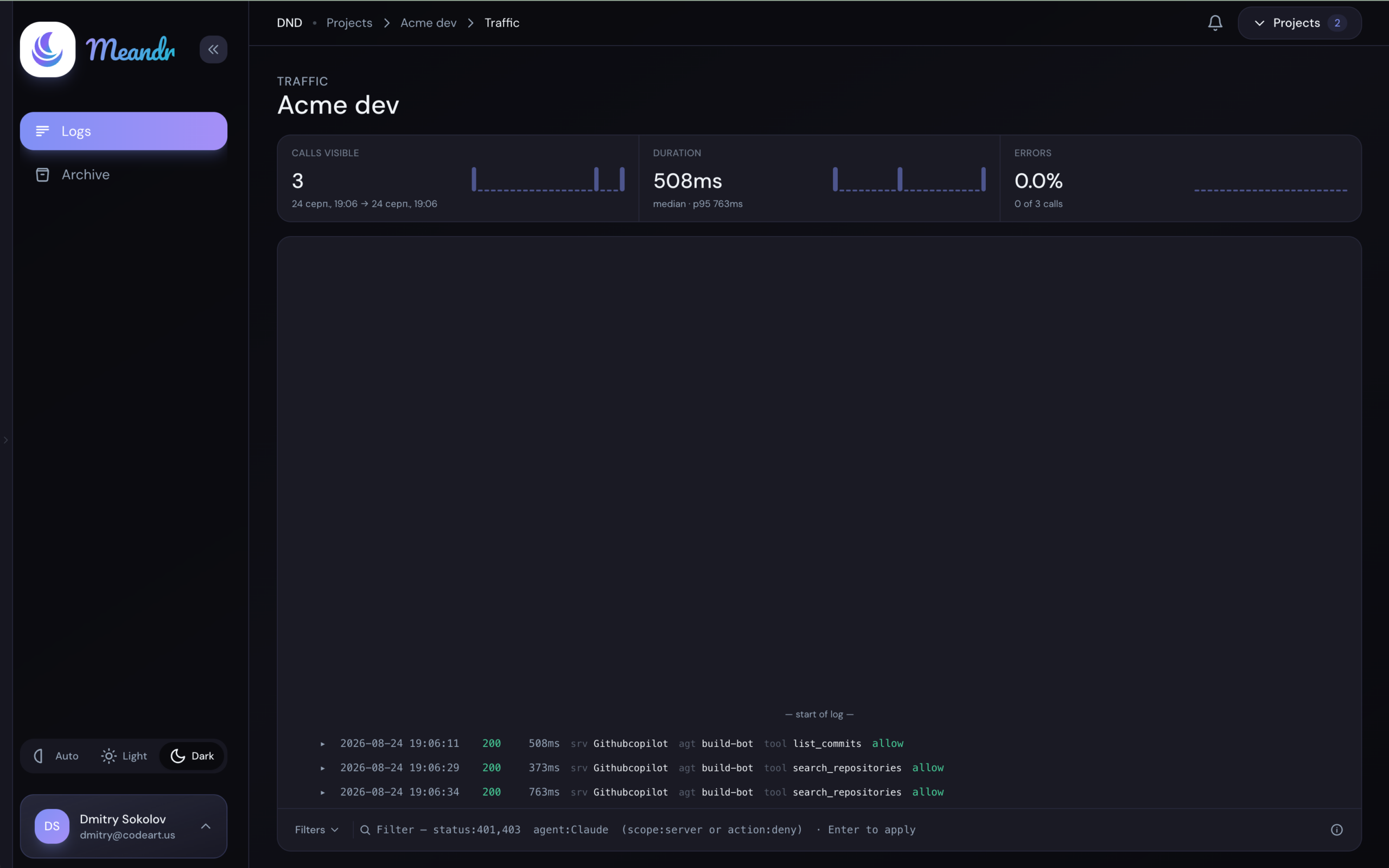
Every call on the record
Allowed, blocked, or held — each call is one line you can search: who, what, when, which rule. Want the full request and response too? Turn on encrypted capture per rule. Off by default.
Questions you'd ask anyway.
Do I have to change my agents?
How does Meandr sign in to my tool servers?
Can I connect AWS-hosted MCP servers?
Does Meandr host my tool servers?
Is this a workflow builder or a model router?
What happens to a blocked call?
Put a control plane between your agents and your tools.
Point your agent at one endpoint and you're governed in minutes — no code changes, no proxy to run.
Get startedQuestions? Email us