MCP Governance
Decide exactly what your agents may do.
AI governance for the tools your agents call over MCP: write rules that read the real call — down to the argument values. Auto-allow the safe stuff, ask a human before anything risky, and keep a full record of every decision: who, what, and which rule made the call.
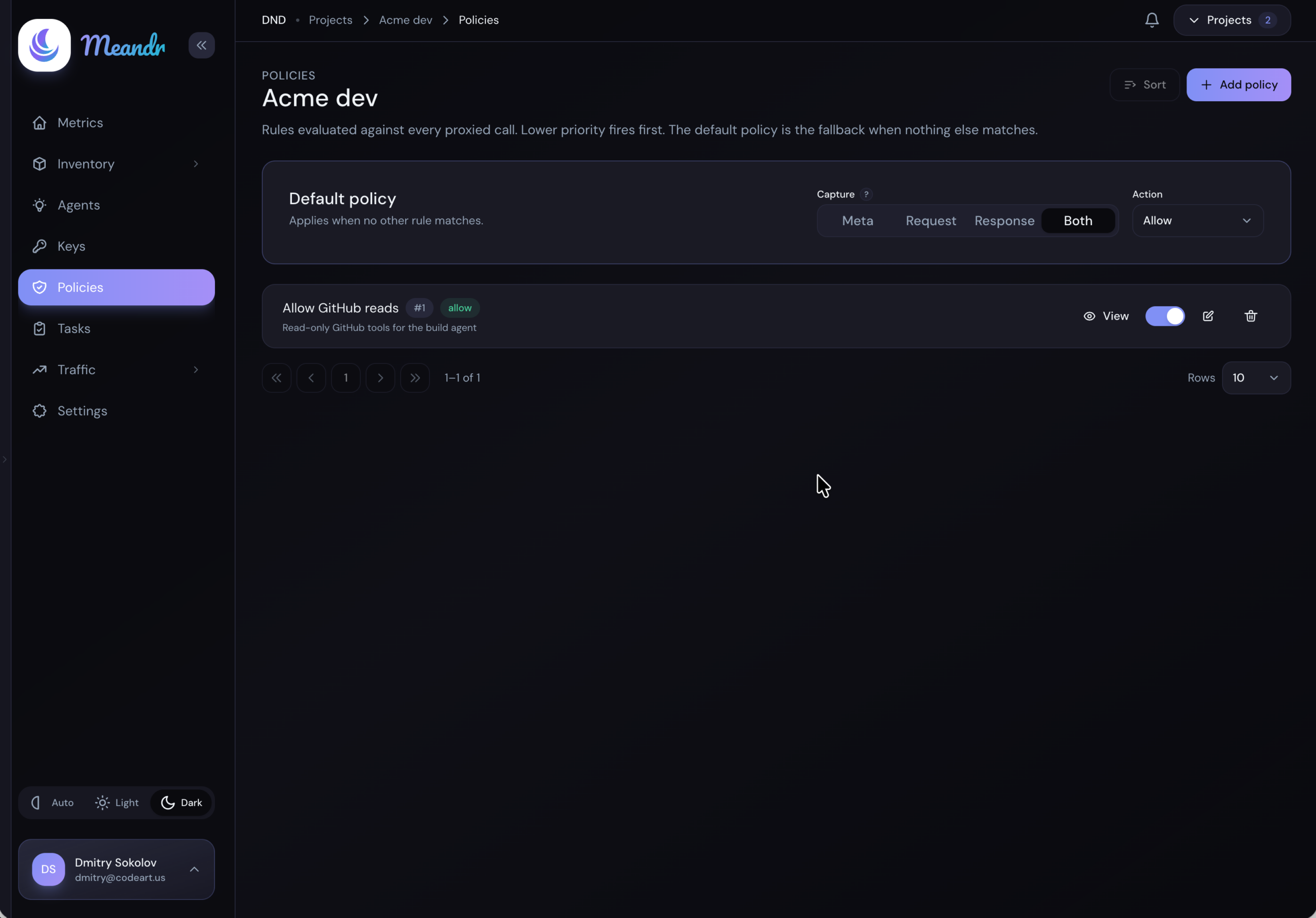
Your rules, in the order they're checked.
Each rule reads the real call — down to the argument values — and runs in priority order. The first one that matches decides what happens next.
Allow or deny a whole tool is too blunt.
The calls that matter live in the details — the amount, the target, the operation — not in the tool's name.
One tool, a hundred meanings
A single "write" tool can mean "update a note" or "delete an account," depending on the arguments. "Allow this tool" quietly allows all of it.
No graceful "ask first"
Sometimes you just want a human to nod before a big or irreversible action. Doing that without breaking the agent's flow — or losing the context of what it's asking — is hard on your own.
No proof after the fact
When it matters, "it was allowed" isn't enough. You need who decided, on which rule, and — sometimes — exactly what was sent and returned.
How it works
Rules, a human when needed, and a record.
Every call runs through your rules on the way to the tool. Most sail through; the ones you've flagged wait for a person. All of them are written down.
Rules
First match wins.
Your rules run in order and each call gets one of three answers: allow, block, or ask a human. Rules can match on the agent, the server or tool, and the actual argument values — "any refund over $100," "anything that starts with delete."
You set up: the rules, in the order you want them checked.
Approve
A quick yes or no.
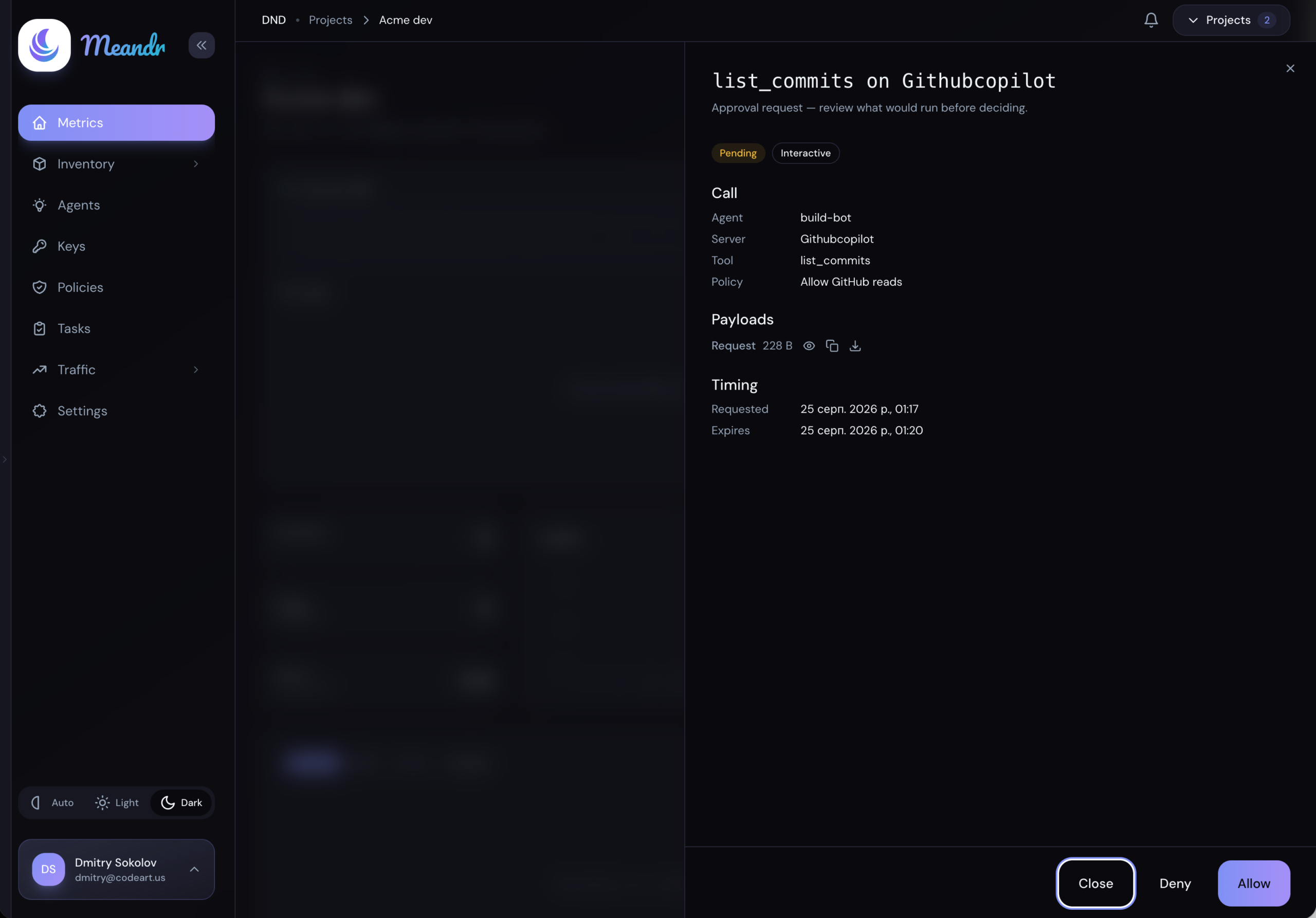
When a rule says "ask a human," the call pauses and a person is notified. Depending on the client, they can decide right inside the agent's chat or from a review screen. Approve and it runs as asked; deny (or let it time out) and it never does.
You set up: which actions need approval, and who can give it.
Record
Every call, written down.
Allowed, blocked, or held — each call becomes an audit record: who, what, when, and which rule decided. Need the full request and response too? Turn on encrypted capture for that rule. It's off unless you ask.
You set up: what to keep, and where capture is turned on.
Control that fits the call, not just the tool.
Fine-grained where it counts, hands-off where it doesn't — with a record either way.
Rules down to the argument
Match on the actual values in a call, not just which tool was used. "Refunds under $100: allow. Over $100: ask a human." — the only real way to govern catch-all tools.
A human, without the friction
Hold the risky calls for a quick yes/no — for supported clients, right inside the agent's own chat. The agent waits; you decide; it carries on. No separate tool to babysit.
A record for every decision
Not just "allowed" — who or which rule decided, on what, and when. When someone asks what happened, the answer is one search away.
Capture only what you choose
By default Meandr records that a call happened and what decided it — not the contents. Want the full request and response kept, encrypted? Turn it on per rule. Off everywhere else.
Sensible starting rules
When a server declares a tool as read-only or destructive, Meandr can factor that into your rules — so you start from a sensible default instead of a blank page.
On from day one
There's always a policy in force — even before you write your first custom rule. Governance isn't a setting you might forget to switch on.
Questions you'd ask anyway.
Can I require approval only above a certain amount, not for the whole tool?
Do you store the content of every call by default?
Where does a human approve or deny?
What happens to a denied or expired request?
Can a rule rely on a tool being "read-only" or "destructive"?
Say exactly what your agents may do — and prove what they did.
Point your agent at one endpoint and you're governed in minutes — no code changes, no proxy to run.
Get startedQuestions? Email us