AI Governance
AI governance that enforces, not just documents.
Your agents don't read the policy doc — they act. Meandr sits in the path of every tool call an agent makes and decides, in the moment, whether it runs: allow the safe ones, pause the risky ones for a human, and keep a record of every decision.
A written policy never stopped a live call.
Most "AI governance" describes what should happen. An agent firing tool calls in a loop doesn't pause to read it — so the gap between your intent and its actions is where things go wrong.
Agents act faster than review
An autonomous agent can make hundreds of tool calls before a person sees any of them. Approving each one by hand doesn't scale; ignoring them isn't governance.
Most governance is after the fact
Frameworks, risk registers, and review docs describe intent. None of them stand between an agent and the moment it does something you'd have said no to.
A rule only counts if it's enforced
A policy that nothing checks at runtime is a hope, not a control. Governance you can trust has to be able to say "no" to a specific call, as it happens.
What runtime governance means
Decide, pause, record — while it's happening.
Runtime governance isn't a document. It's three things that happen on the live call itself — before it reaches the tool.
Decide
Down to the arguments.
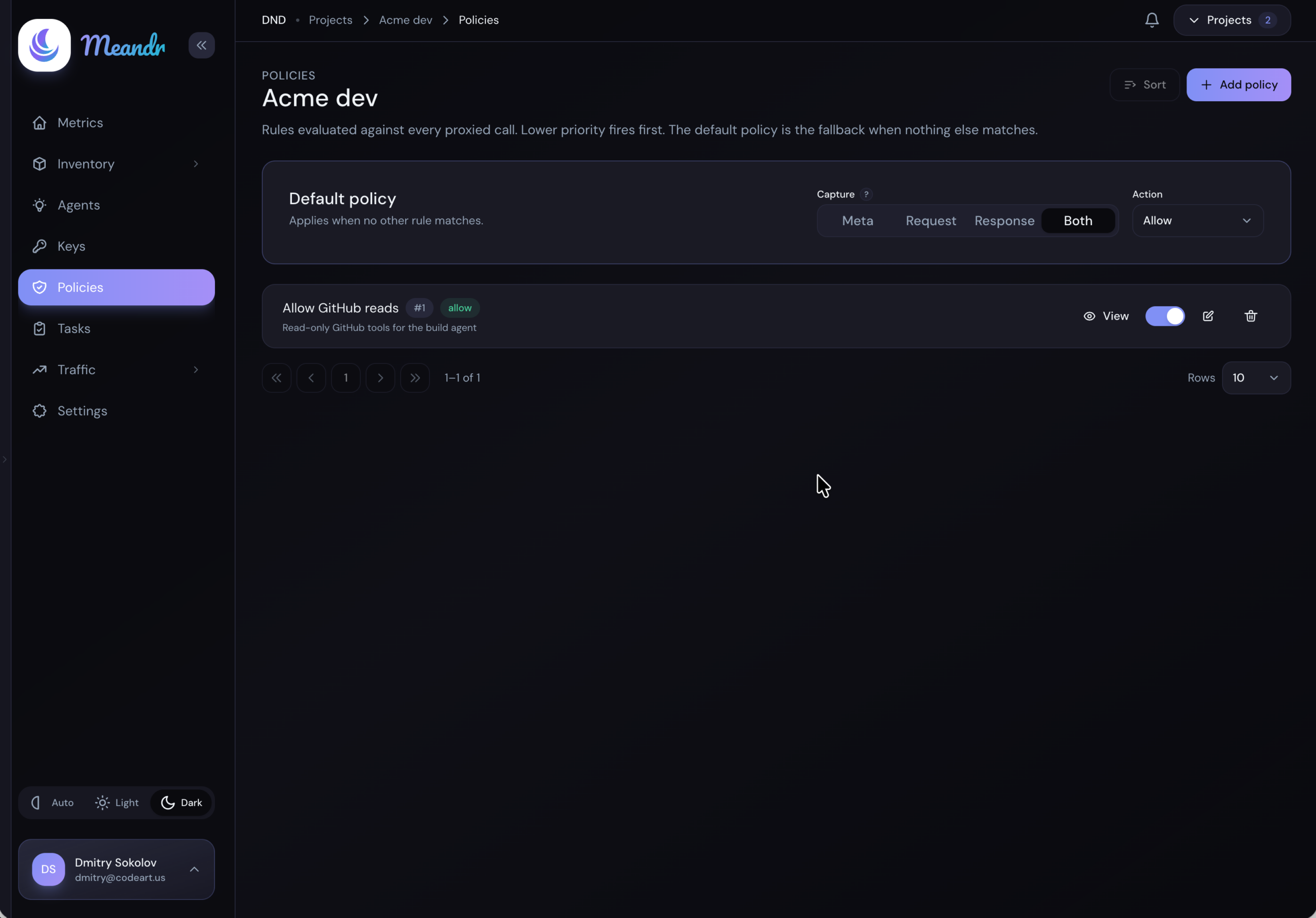
Say what an agent may do — not just which tool it can touch, but the actual values in the call: "refunds under $100, fine; over $100, no." The rule reads the real request and answers allow, block, or ask a human.
The point: the risk lives in the details, so the rule has to see them.
Pause
A human on the risky ones.
When a call crosses a line you've drawn, it stops and waits for a person to approve or deny — for supported clients, right inside the agent's own chat. The agent carries on only if someone says yes.
The point: oversight without babysitting every action.
Record
Every decision, written down.
Allowed, blocked, or held — each call becomes an audit record: who, what, when, and which rule decided. When someone asks what an agent did, the answer is one search away, not a reconstruction.
The point: governance you can show, not just assert.
Where Meandr fits.
Meandr is the control plane between your AI agents and the tools they call over MCP — the layer that turns a policy into enforced behaviour. It's not another dashboard of intentions.
In the path, not beside it
Every tool call an agent makes passes through Meandr on its way out. Nothing routes around the policy, because the policy is on the wire.
Decides before the call runs
Allow, block, or hold for approval — settled against the real arguments and applied before anything reaches the tool. Enforcement, not a warning after the damage.
No agent code changes
Point the agent at Meandr's endpoint — standard MCP over HTTP — and governance applies. You don't rewrite the agent or wrap every tool.
Proof of every decision
Each call leaves an audit record of who, what, when, and which rule decided — metadata by default, with full request-and-response capture you can turn on per rule.
Fleet-wide limits
Cap how hard your agents can hit a server across the whole fleet — per project, per agent, per server — so one runaway loop can't run up the bill or the blast radius.
It complements your program
Keep your framework for the paperwork and evidence. Meandr is the piece that makes part of it binding at the moment an agent acts — the enforcement point, not a replacement for the whole program.
Questions you'd ask anyway.
How is this different from a GRC or AI-governance platform?
Do you map to compliance frameworks or score model risk?
Do I have to change my agents to use it?
What can a rule actually see when it decides?
What happens to a call that gets denied or times out?
Turn your AI policy into something that actually stops the call.
Point your agent at one endpoint and you're governed in minutes — no code changes, no proxy to run.
Get startedQuestions? Email us